Now that the dubstep wave has swept through the US at full speed for a few years now, the harder styles --which still remain most popular-- have settled in, which has paved the way for other low-end dubstep styles to gain recognition and further integration. These styles were typically less popular with the massive domination of mid-ranged rave anthems. They became increasingly less so after some producers started feeling marginalized in a way, and began to avoid the dubstep label altogether. Although still embracing the “space/bass/pace” ethos dubstep originally nurtured, these artists moved the label of their experimental bass music into a vague, eclectic, and temporary realm. DSF awards had classed it even so basic as “120-140 BPM”. Regardless of this dichotomy the scene on the whole is healthier for of it. That's because those alternative styles which had remained in the bass-heavy 140-area are without a doubt still dubstep. No matter how you want to slice it up and label things… it’s all still dubstep. DnB, Grime, UK Funky, Moombahton and Techno have all become factors at play as well, but that doesn’t mean dubstep’s influence should go unacknowledged simply because it’s so obviously penetrating within EDM today.
So then, before going off topic I was alluding to dubstep's appeal beyond it’s original scope. It’s infiltrated itself from the commercial ends all the way to the left-field underground; well beyond more than just ravers and party people too. This inevitably led to an ‘acquired taste’ for bass-weighted material for the masses. It created a familiarity with the sound that was not readily available to break through in the earlier stages of the global distribution of sonic pressure. Instead, over the 5+ years since, the scene has been clouded by those dominant dance-floor decimators. But now that these harder styles have settled-in, those sub-sets are rising in notoriety enough to breakout on their own.
On a cultural take --which this blog is about-- I think it’s good having producers come through being well-rounded, and mixing various related styles and genres. This positive diversification gets further enhanced if these producers also bring multi-dimensional selections to their DJ sets as well. It would be a huge plus for the scene in general, which harbors the heavier mid-ranged wobble disproportionally, (for better or for worse depends on perspective). One of these sub-styles was the “purple” sound, which I had reviewed last month via an 805 loke, Toro 43’s EP release. As previously posted, “purple” is what I defined as, (via Rebel-Elite Toro 43 feature):
["Anyone unaware of a difference, these are just my words but I believe they sum it up well: The concept of “purple” comes from the heavy synth-laded production work, labeled such to purposefully differentiate it from dubstep. The color term is because the synths are rich, 'colorful' textures. Personally, I refer to it as "purple" not "purple dubstep" as some rightly can. Besides the obvious dubstep traits, and those additional grime attributes, I also associated it with Wonky; (think Scotland’s Hudson Mohawke and Rustie). With purple, you can hear the color in it. Whereas dubstep in it’s original (now muddled) concept, was classed in a dark, black-voided spatial ethos. Purple was meant to counter that idea, and create synthetic light in the extended space created by the patterns of production that dubstep was spearheading at the time."]
So as you can tell it’s hardly a new sound having gone 2008 and strong. But in regards to a proper execution of these characteristics on west-coast productions… they always came few-and-far between. Whereas Toro 43 has pushed this for a while now… he’s also not recognized in other areas of production in the dubstep scene (yet his Moombahton is kicking off right now though!). Other, more-recognized producers on the south-coast have started coming through. I view these bass-producers as exhibiting a wider painter’s palate for their musical canvases. Over the past couple weeks I’ve noticed it being embraced by a few select in the LA-area. And when I mention west-coast bass, don’t get it twisted with the ease-vibed bass music that came from glitch; that which is being facilitated by Do-Lab type crews. What I’m on is 140-bass still though, rooted in the original dubplate culture, dubstep and jungle both derive from.
One of these producers is the extremely diverse Ashtrobot. He just broke out heavily in the LA bass scene last year, and just a few months ago produced a few hip-hop tracks for Kendrick Lamar, further propelling himself upward in the industry. Ashtrobot has not shied away from the purple qualities either. He just gave out a free tune sampling the ASAP Rocky’s “Purple Swag” vocals. Coming heavy nonetheless, the synth textures in the tune separate the sound from the overtly intense rave wobbles --which you should know, the producer also throws down relentlessly.
Another producer-DJ is Direct Feed, an old-school selecta representing the LA-area for years as Dotcom. Direct Feed has of late been pounding out everything from DnB, to Moombahton, and Dubstep… and everything in between like Drumstep, Moombahcore and now, “purple”. As I mentioned earlier, if these diverse productions can also be played in tandem with various, eclectic DJ selections, the entire bass scene will benefit immensely. Direct Feed is just that guy. I’ve had the opportunity to MC a few of his sets, and was always impressed by his selection and technical ability. He creates a crowd-pleasing edifice as a 6ft+ producer towering behind the decks. Earlier this week he made his first “purple” experiment, and put it out to the public. A remix of one of his favorite tunes at the moment, The Weekend’s “Rolling Stone”. This one came off ultra-chill, on some deep vibezing shit. Basslines massage the mental, over the sexy vocals one you always get from The Weekend.
Direct Feed had relayed to me that he and had become keen on the sound through Ashtrobot, a neighbor of his in Long Beach. It seems while the rest of LA drives through smoggy grey skies, the LBC is blazing up the beach to purple sunsets. Must be that weed thang. Lemon season all the time. Wish I had more to share, but I think it’s still nascent as far as productions, on the south-coast. I think it’s because the glitch-style, developed on the west-coast and BC, has become its alternate for those more-subtle bass vibes. Regardless, I hope these artists continue to push this purple sound. It’s been far too long coming. P.E.A.C.E.
Over the past few months, I’ve been waiting on a release project from a Santa Barbara-area native, and one of the few talented producers in our coastal paradise. In these technologically innovative times we live in, it’s clear that everyone wants to be a DJ. In a 21+ college and beach town like SB, they are everywhere. Producers on the other-hand, despite the rapid tech advancements in this field as well, still requires long studio work, high expense, and of course, an abundance of artistic creativity in order to break through to new listeners effectively. Quality productions seem especially hard to come by in Santa Barbara, where just an hour down the way is the megalopolis of Los Angeles, I've seen to too many 805 talents breakout, then bitter-sweetly --and with best wishes-- watch as they depart for better opportunities. But as the city gains a wider EDM scene in general, the producers have steady been churning out. Last month I posted my fourth artist feature profiling Toro 43’s debut release, the purple-electric "Lavanda Summa" EP which you can check out and download, here. Now again it’s my pleasure to bring you top quality production from another Santa Barbaraian, Seven Lions.
I had been hyped on this release for a multiple reasons. First, Seven Lions is the new pseudonym for progressive-house Producer/DJ Jeff Montalvo's dark-side, who has been consistently rising in notoriety. He released his first EP last year, a 5 track effort entitled "Movement", available on Beatport via Elliptical Recordings. This progression reached a climax when DJ Tiesto gave radio-play to his track, “Under Pressure”. Any release from Jeff Montalvo is something to track down. With a disciplined drive and high standard for quality music, the output is always a listening pleasure. Secondly, as mentioned, Seven Lions is the alternate identity for the heavier, bass-oriented side of Jeff Montalvo. Before entrenching himself in the world of EDM, Jeff was originally a metal head as a yout. As the transgression of American dubstep came sweeping through, it was only a matter of time until metal lovers found common ground.
This is no surprise since dubstep treats the genres before it like a harem, developing strong relationships with eclectic influences. Such crossbreeding has occurred regularly in dubstep with hip-hop, DnB, dub-reggae, electro-house and the west-coast beat-scene. The first time I heard Jeff Montalvo’s dubstep was upon our introduction, after Professor West had dropped a dubplate of his at a Santa Babylon show last year. At the time, Montalvo was still experimenting with the sound, having made a remix series of sampled metal tunes into dubstep.His EDM productions, which tend to be house or trance with a progressive flare, may seem at odds with the heavier, raved-out dubstep sound... but to Montalvo, it was really no long ting. Lastly, I was looking forward to the upcoming release because he had relayed to me that it would feature a partnership with a south-coast rapper, as well as a few other vocalists.
That rapper was Lexo the Great. Although currently residing in the LBC, Lexo is also from north-county Santa Barbara area. The 805 has always played an integral role in his musical and personal development, so I was pleased to hear the collaboration would feature another 805 loke. Similar to Montalvo, the last couple years have been precipitous of big things for Lexo the Great. In 2010 he released a respectable 4 mixtapes on top of a street album, dropping several videos along the way. In 2011 he performed with rock-reggae sensation Iration on their So-Cal Tour and SXSW. This momentum culminated into Lexo releasing his latest single “Another Day” feat. Iration, which is available on iTunes, here. Continuing in positive fashion, Lexo is making massive steps on his new album, working with reggae icon and Grammy Award winning producer, Native Wayne Jobson. I was just recently booked alongside Lexo in Malibu this past month and got to see him live. With a genuine character and vivacious stage presence, it solidified Lexo the Great as a charismatic performer in addition to a recording artist. And I look forward to rocking mics with him again, this time in Santa Barbara on August 12th @ Statemynt Lounge.
805 pride aside, in actuality this release will get play well beyond city limits. The "Keep It Dirty" EP stays true to the name, with Seven Lions' production work going into serious head-banging wobble frequencies alongside Lexo’s party rocking bars which are always on point, and keep the dance-floor moving. In dubstep, the vast amounts of hip-hop vocals (original or remixed) in the scene these days, I like it when a producer doesn’t go over the top by layering vocals all over the mid-ranged drops. Instead, Lexo’s vocals work in tandem with the track’s drops, hyping up long beat-laden intros, or breaking out on the breaks before Seven Lions sets it off again with the second drop. Seven Lions, as a classically trained practitioner, puts a high emphasis on melodies. As such, he generally doesn’t find synchronicity working with rappers for this reason, and typically prefers sung-vocals to work with... or nothing at all. With this format and chemistry on the “Keep It Dirty” release, Seven Lions’ arranges the tunes to be consistent quality, while maintaining unpredictability throughout the entire tracks. This is especially evident on the one track I wasn’t granted a dubplate for, and happened to be my top rated on the EP.
The tune, entitled “Back Down” was last to be recorded due to a feature from Michael Peuschelof Iration. Lexo licks off two dope 16s between drops that both build-up & breakdown like a warning alarm for incoming bass bombs. Then following the third verse section comes Peuschel’s thirty-second instrumental guitar solo. The track not only maintains a heavy production, but also manages to do so while echoing hip-hop, to “brostep”, to rock/reggae styles all at once. In the multifaceted evolution of dubstep, ‘progressive’ is almost a non-use word in this rapid changing and dynamic sonic environment, but with Seven Lions, it’s certainly applicable. His ability to encapsulate these different aspects of dubstep’s hyper-evolutionary character into a single amalgamation, showcases his innovative production styles. Further adding to a maintained interest throughout, the duo brings in relief features such as the aforementioned Peuschel, the lovely Sarah Clark, and one of Lexo’s mandem, Fedie Demarco,who features on the bonus track; a Watts remix of the EP’s stomper riddim, “Fully Loaded”. Best of all, as it's Seven Lions' debut release, the decision was made by both artists to release this top-notch product for FREE. So the next time you hear the name, you’ll know what’s up!! Grab the EP for free via Seven Lion’s SoundCloud, or directly down below. And don't forget to get that sick cover art by graphic artist Cliff Nelson, who also did the art for Montalvo's Movement EP.
And an EP release wouldn’t be proper without a party, right? And sure enough Seven Lion’s and Lexo will be lighting up the sound system at Statemynt Lounge on August 12th, for the Keep It Dirty Release Party. This is going to be a rager, with an ace line-up of mixed-genre EDM. In addition to Seven Lion’s headline act, the night will include sets from DJ's Rene (Underground Souls), 9FTOFSMOKE (BluntBros.FM), as well as Zander, a wicked glitch-bass Producer/DJ who is also collaborating with Lexo. Just got word that they will be showcasing an unreleased tune at the show! Come in early and celebrate the summer with us, as well as this massive release of bass-weighted pressure. Support your local talent. Again, download the EP below, for free, and check out www.jeffmontalovo.com andLexotheGreat.com for future updates and material. P.E.A.C.E.
Just finished up my first proper mix… On that MC-to-DJ ting. Some cool down vibes via sub-bass pressure reverberating your mental; sans the midrange wobbles. Any trigger happy LFO tunes in my mid-levels are replaced by ace vocals. Blends of easy ‘purple’ vibes, deep half-step rollers and neo 2-step grime riddims, all laced up with 140 vocalists; be they rappers or singers. I decided to call this “Post-Grime” for multiple reasons. But before that, let me start of by saying this label isn't a label, just the title of the mix. It's simply a term to describe something; a pattern. So don't take it as a re-label fashion at all, it's just art, yo. Although these styles crossover into different classifications... for all intensive purpose, "post-grime" is really just "grime" music... please understand this foremost.
Now, my motive for the post-grime statement: First, the obvious derivation coming from the recent influx of a “post-genre” branding which has been heavily used in particular reference of the 140 offshoots of UK garage; dubstep, grime, 2-step, bassline-house, UK funky, and most recent, the ominous “future garage”. In some ways, this mentality recalls the spirit of dubplate culture, which speed garage and then later 2-step, had inherited from the jungle days when they shared two-room venues. Unfortunately, the influence has gone wayward in the digital age with the decline of vinyl dubplates, but also a lack of the cultural understanding by people who simply liked the music, and saw no cultural connection or any need for a connection. A shame, but no fault of theirs. All aside, the principles of anti-traditional, forward thinking production values remained from the dubplate-era, and is further enhanced by the vast amounts of musical influences and sonic technologies interacting with one another nowadays.
“Post-Grime” also speaks to a more musically inclined definition of the same concept. As mentioned, all the 140 genres have been cross-pollinating amongst each other, and it has only accelerated of recent. Where grime has always been very vague in the definition of what constitutes “grime”, the emcee was always the deal-breaker. Not any emcee mind you, a grime MC. Put a grime artist on UK funky, dubstep, ‘purple’, and even some hip-hop or reggae… it can be labeled grime to a certain degree, and hence the crossovers begin. This idea also holds true to this mix. It’s interlaced with various different, yet related-genre styles, with constant vocal features by an array of diverse grime emcees. Think, “Post-Genre with an MC”.
Now amongst the classifications of “post-genre” branding, grime is the least likely to be considered so. These “post” labels are typically applied when its predecessor has collectively lost its way, as most music styles and cultures inevitably do. In fact, grime is probably the most healthy it’s been since its inception in the early-2000s. Of course, the same can be said for its sibling sister dubstep. But while the Croydon star child is enjoying mass success, it has completely transformed from its original production principles. Think, “Jungle to DnB without the name alteration.” If that's success to you, then we just belong to different schools of thought. ‘Niche’ aka Bassline-House, another UKG offspring of the Midlands UK, has all but fallen off. But artists brought up through the grime scene have had more chart-tunes this past year than ever before. Skepta, Tinchy and Chipmunk all had massive years, though not always putting out grime, they are indeed a legacy to be lauded and supported. The grime-bred pop-stars are best epitomized by Tinie Tempah’s global chart success, have just recently received the BET award for best international artist.
Grime’s not just in the pop charters either. Dubstep’s massive appeal on the airwaves has also helped grime artists and producers, such a the respective P-Money and True Tiger, gain exposure in the at massive festivals, raves and cubs. The rise of the Butterz label, run by Skilliam and Elijah, have given grime its vinyl back, and the imprint is building a quality discography and paving the way for more instrumental releases, which were sorely lacking in the emcee dominated mixtape-era just a couple years ago. And just last year, finally a North American, Tré Mission out of Toronto, ascended the implausible act of breaking out within the UK scene domestically. But there are reasons as to the aversion of the grime label…
I wanted to avoid a general application of “grime”; again for multiple reasons. Foremost amongst them was my audience. I’ve decided to push ‘this sound’, whatever you want to call it. And as opposed to my success in pushing dubstep for a few years now **Note: strickly as an MC//Promoter**. I’m not really aiming for those ravers either. This shit for the hip-hop heads. I’ve immersed myself in this enticing, fresh 140 BPM hotbed for over 3 years now, and have pretty much stopped listening to hip-hop. Even before my style altered, my taste already had. Hip-hop just seemed to have lost the edge it always had as I started to feel I had heard it all before in some fashion. But I never stopped loving hip-hop. That's because, as KRS-One proclaimed, “I AM HIP-HOP”. Any music I listen to applies this urban street culture I’ve always been apart of, and it always will. So instead of trying in vain to expose the grime scene to Americans, it's better to start it off fresh, for the time being. Pushing "grime" just isn’t effective, and usually loses more listeners than it gains. For some odd reason, grime is a tainted name. I think it may have something to do with the abrasive, raw production style and hardcore, violent wordplay. But I actually believe it’s because it’s marketed (usually in vain) to the EDM ravers, especially stateside. (That's why as an introductory mix, I'm attempting to appeal to new listeners by I avoiding the harder, raw, high-energy grime tunes). True, dubstep and jungle both have solid roots in hip-hop, but only to a certain level… but grime pushed those boundaries between EDM and hip-hop further than ever before. With that, EDM ravers also tend to not be hip-hop heads either… there is only so much subculture to go around in one’s life. So fuck the rave, this that street bump shit. Night crawlin’ riddims. Not to say that you can't skank out on this, cause that's what grime is too! Keeping it raw and street, while still keeping people breaking out on the dance-floor. This is the beautiful balance of grime music.
But it’s not just that behind my “Post-Grime” concept. You see, similar to jungle music before it, grime isolates itself to its central hub, London. It cannot realistically be accessed by an outsider… you almost have to be brought in by the existing establishment; the controllers. So essentially, I will begin to expose this music stateside --not just through DJ sets, but through original productions, vocals (without British accents), andevents. But with my status, I will never be accepted amongst the meaningful, core artists in the grime scene. Upholding this LDN isolation, I truly believe this to be one of grime’s biggest detractors, and has unfortunately limited a music that had so much potential on the outset. So “Post-Grime” attempts to avoid the grime label, while still remaining true to the culture, even if in an oppositional way. If they want to close themselves off to outsiders, then I’d rather not call my style “grime” in return.I’ve come to believe this will help break the sound transnationally, as listeners here will inevitably trace back to the UK original sound. Also, as I try to introduce this new style to all my hip-hop heads, many of which just do not get down with dubstep or other EDM --myself often included-- a vague, temporary label will help facilitate its own forward progression, with no strings attached.
Expect much more of this sound… cause I’m going all in. Currently working on some tunes with a few producers in South Cali. I wanted to use this mix as the kick-off for my stateside “post-grime” push. Mixes will get a bit hard and more "grimy", but I wanna ease it on ya, get me? All I ask of you, the listener, is keep an open-ear and an open mind. Even though it’s quite a divergent and unaccustomed sound… I just know you’ll feel it.So let this mix introduce you to my wonderful world of “Post-Grime”, cause this is just the beginning. P.E.A.C.E.
---
*If your vibezing off this, and want to know more about grime, check out rebel-elite's intel, here.
**The Post-Grime mix has been taken down on my SoundCloud and replaced with Post-Grime:DEUX. However, here is a download link to the original concept mix.
Summer has finally arrived! In SB, you can still count on the A.M. June-gloom rolling in, almost as dependable as the afternoon sun that's sure to creep out. But this particular grey morning I was pleasantly surprised to get a bit of light and color through my speakers. My top-rated local DJ amongst the 805’s relatively small pool, Toro 43 (formerly Bless the Sinner), just put out his first release which he’s giving to all of us. Even though I was surprised just now to come across it, I really wasn’t taken aback to realize man had already put it out lastmonth. Toro 43 aka Danny Mesa, is a straight talking, unpretentious Santa Barbara native and old-school 805 selecta. So as a humble individual --which speaks to an authentic character-- it also makes him the last person to be pushing his music so heavily on other people. Luckily, his music speaks for him. In a relatively small town, generic dubstep is everywhere, complete with with over-the-top LFO bass wobbles in a scene where a preference for dance-floor familiarity has overtaken a drive for anti-traditional innovation. This is expected in a smaller peripheral-city, but in my experiences Toro 43 always kept an eclectic, unparalleled selection, while rocking heavy dance floors with his mixing and live-act sets of bass-weighted pressure.
His sound selections had always appealed to me, whether it be glitch, grime, DnB or electro influences behind the vaguely labeled “dubstep” overtone which people often attach to a lot of bass DJ's various styles these days. On that personal level, it was probably because Mesa was the first to embrace the “purple” sound which I was heavily into at the time in came out. That was the sound Joker and Kulture displayed on MAH's Generation Bass in late 2008, just before I met the man that is Toro 43. For some reason, I’ve come across a lot of heads that seem intent of describing the comparisons and contrasts with dubstep and its various off-sprung sub-genres. I guess I could understand that, but it would be difficult for me to describe, or rather 'not-ascribe', a difference between the overarching label dubstep entails at large, and another one of the many sub-genre titles. But with "purple", specifically the pioneering work of Joker, I always considered it in many ways to be more grime when I first fell in love with sound. So I never felt a need to differentiate it from dubstep, as it was never apparent to. Even though in the many ways it retained some character of the London star-child at its base, the Bristol-lead purple sound was always separate to me. Which was then followed up by Ginz, Gemmy, Guido and Starkey becoming strong sound pushers of the purple movement.
Anyone unaware of a difference, these are just my words but I believe they sum it up well: The concept of “purple” comes from the heavy synth-laded production work, labeled such to purposefully differentiate it from dubstep. The color term is because the synths are rich, 'colorful' textures. Personally, I refer to it as "purple" not "purple dubstep" as some rightly can. Besides the obvious dubstep traits, and those additional grime attributes, I also associated it with Wonky; (think Scotland’s Hudson Mohawke and Rustie). With purple, you can hear the color in it. Whereas dubstep in it’s original (now muddled) concept, was classed in a dark, black-voided spatial ethos. Purple was meant to counter that idea, and create synthetic light in the extended space created by the patterns of production that dubstep was spearheading at the time. Now as I’ve said, it can legitimately be called dubstep as well, but it should be noted, this is not a conflicting juxtaposition either. These days, the cross-pollination of 140 genres is undeniable, and probably the most diverse and exciting in the current EDM environment. As an original regional pusher of the sound via his productions and live/mixed sets, Toro 43’s art bleeds with diversity and excitement. But until more recent, the latter had been his trademark: DJ mixing and live sets. But Toro’s high standard and quality-over-quantity mentality toward his own productions have finally seemed to reach equilibrium.
The EP is a 6 track digital giveaway entitled “Lavanda Summa”. The kick off track of the same title, Spanish for “Lavender”, alludes to the purple frequencies forthcoming on the release. Sure to sonics, the opening track is a synth-lead propulsion with colorful overtones. The unimaginative could call it ‘daytime dubstep’, a perfect choice for a relaxing beach day in the summer. The next track "Licorce" comes on, if not decidedly darker, certainly deeper. That summer's day falls toward sunset, a “lick-a-spliff-off” moment when you’re content knowing the nights vibes are just around the way. On comes a tingeing swath of an electrified, guttural sub-bass reminiscent of the glitch-inspired type I’ve been hearing from Do-Lab affiliated artists in Cali; but maintaining a purple/dubstep continuity, which leads into cross-pollinated blend to his work which just generally can’t be classed in full. After so many inspirational sounds coming out around the globe, the boundaries between genres have become so porous they've almost become worthless. The third track, "Baby Food" gets even darker yet, more akin to a traditional dark stasis-inducing pressure of Croydon-esk dubstep, which Toro then releases in waves of sharp, ragged basslines upon the drop.
Moving on into the only remix on the EP was the producer’s rendition of the Bassline-House’s massive hit, “Heartbroken” produced by T2. The northern “niche” music of the midlands UK never really caught on stateside, probably derailed by the advent of the similar, domestic Fidget-House scene. As a consequence, Toro’s use of the now-classic vocal by Jodie on the original feature, creates a fresh reception for a lot of the west-coasters I’ve shown it to... as a good remix should. The remaining tracks onset the summer’s darkening evening sky. What separates the “Lavanda Summa” from a 'traditional' purple productions (for lack of a better word in a hyper-evolving forward-driven scene) is the electro-infused production values it retains, while still being inherently of a “purple-dubstep” quality. That shouldn’t say it’s what separated Toro’s release from the UK-originated style, what it did however reveal to me is the similarities of the massive and diverse sound that has become "electro" (which I'm honestly not very familiar). Nonetheless, the EP seeps with a static electricity, epitomized by closing track titled “Square Meal”, which simotenously builds-up and relieves a constant pulsating tension, giving the EP its dark, dance-floor mover. And just as the EP comes to a close, it seems the summer’s night has arrived... but now so has Toro 43.
His first release is long coming, and it surely lives up to the work Toro has put in over years. When I caught up with him earlier this spring, he relayed to me even bigger things on the horizon. The South and Central Americas EDM scene has been blowing up the last decade, inspiring a taste for electronic-latin-funk around the world. Toro 43 has ventured into bass-heavy experimental Cumbia sounding production work, as well as familiarization with the rapidly expanding Moombahton sound. I’ve yet to hear any of it, but if it’s anything like Dutty Artz’ NYC Tropical sound I favor so much, it would seem Toro 43’s productions are tailored for me. But it’s not… it's simply just good music with an innovative approach. Behind the creative-artist of Toro 43, lies the intellect of Danny Mesa. A conversation with the producer will reveal a pure love for music, while being able to convey in substance exactly what he it means to him. But true to his work, he usually prefers to let the music speak for him. So download the EP for FREE off www.toro43.com, with cover art any Santa Barbarian will adore. (Mesa is also a graphic designer). Grab some of his ill mixes while you’re at it. And be sure to keep up to date with all his sounds via Toro 43's SoundCloud. This year man is sure to be making major moves throughout 2011. And in the meantime, Happy Solstice... now let’s bring on the Lavanda Summa. P.E.A.C.E.
Hypes been abuzz in the fashion world for 2011. No, it’s not Kate Middleton or her hot sister. Urban fashion icons Akomplice have once again teamed up with the musical curators of our grimy, urban environments. Akomplice prides itself on the creative inspiration that drives its clothing line. In their words, the apparel they create attempts a “positive impact, provoke thought, and communicate about issues.” As we all know, hip-hop has been the cultural movement most evocative of these ideals. So when a classic, innovative, and conscious hip-hop apparel company collaborates with a representative artist… it’s a mad ting. Keeping in line with images and thoughts conveyed in their art, the aritst’s AK collaborate with no doubt share these forward thinking traits. Detail is another crucial aspect of Akomplice that I've admired for a while. Their tendency to use simplicity in some instances actually comes across as being a component to an overall complexity toward the meaning they are trying to convey. Get me? No worries.
Last time I linked up with AK on the interwebz was when they teamed up with Hiergolyphics on the wicked Varisty Hoodie (stillavailable online). Check out that piece covering the release reception, here. This time, the peeps at AK linked with DOOM. Formerly MF Doom, the rapper has been an underground legend for years. His easily distinguishable, kicked-back flow and ace lyrical content has blessed DOOM with a loyal following and mass appeal without any major label assistance. Even more impressive than his personal work is his other collaborative works. In addition to Akomplice, DOOM has collaborated with Danger Mouse as well as Wu-Tang; notably producing tracks for Ghostface, as well as Think Differently's compilation which featured DOOM and RZA on the experimental “Biochemical Equation”. Pushing it further forward on the left-field urban tip, DOOM, a former British ex-pat collaborated with Dabyre, which included offical remixes from FlyLo and Kode9. Massive respect to DOOM on that one, as the LA beat scene and the stateside dubstep were still relatively nascent at the time.
So as it is... a collaboration between DOOM and Akomplice is simply something to anticipate. But what exactly are we waiting for? That’s just it… no one knows, that's part the hype. The project remains a mystery as the fruits of this gauranteed-sick collab are sealed inside a wood box, with the DOOM and AK logos branded beautifully on the exterior. Don’t have a crow bar to pry it open? That’s cool, Akomplice got you covered with an engraved one matching the box's complimentary artwork. So you want to wait to find out what’s inside?? Well since that’s no fun, this purchase will only be available for 1 day on their online store. But hurry up, cause the clock is ticking and you don’t want to be without this. Whatever “this” may turn out to be. Done know!
Additionally, the item will be available at the AK’s storefront location in partnership with your Fuzion, on State Street, Santa Barbara. AK just hosted their summer release party, with some sick threads from their new collection. Patrick McCarney and the AK team blessed Santa Barbara with some ILL hip-hop with some ILL hip-hop acts throughout the night, imported from AK's former HQ in Colorado. Fuzion also brought back KC badman, and SB resident Chadillac, always kickin' the flavor in your ear. Following some high energy performances, an after-party at Tonic featuring a fashion show with some hot models modeling this summer’s hottest apparel. Be sure to cruise through Fuzion every first Thursday and check out some amazing art, clothing and music with some awesome people. The new Fuzion x AK partnership is sure to elevate both companies stature in this 805 coastal paradise. My bwoy X-seed was the first in-line for the event, and always lookin' out for their supporters, the crew HOOKED him up with madd gear. So get down there July 7th and party proper with the AK and Fuzion boys. And don’t forget to pre-order your mystery DOOM x AK piece TODAY. Check it... the clock is ticking!
Earlier this year, the UK network MTVBase aired a special about the UK’s best emcees of 2010, which was determined through a panel-points system. It was widely publicized and developed into quite an event, and rightly so, considering the UK's urban talent pool is finally being recognized globally. Twitter and blogs went abuzz with all-out rejections of certain people, as well as new suggestive lists written up. Of the new entries, there were expectedly a few constants. Ghetts, Kano and Dot Rotten fans appeared on forums with severe expletives as to why they should have been put on. Ghetts even took it further releasing a music video dissing the panel and the selected. But another name also surfaced with regularity: Durrty Goodz. The difference with him, however, was a lack of ludacracy on those same forums regarding his omission. It wasn’t surprising; in fact, it's almost become expected.
Doogz has been the most underrated artist since grime had artists of recognition to begin with. Personally, I’ve never understood this. One factor may be his rapid-style which may lose listeners; yet I find it to be one of the most punctuating and clear dialects within British grime. Maybe it’s his refusal to sacrifice his musical style for money, having rejected numerous label deals. Perhaps it’s his output consistency, which is relatively minimal in the hungry-for-moar mentality of grime fans. This would seem to be the best hypothesis, however no one can really knock Doogz' work ethic. That’s because when his releases are put forth, it’s a fucking mad ting. The quality-over-quantity discussion runs ramped over the waves, and Goodz is the primary example of the former. Whatever the reason, it has become standard practice to deny Durrty Goodz the due recognition. But every time ‘a season, man comes out of seclusion to shake up the scene and silence all critics. It’s these moments of musical reverence as to why I maintain that Goodz is the most underrated of artists, the best MC alive on the planet, and maybe single most talented rapper since Tupac. There I said it. Now let me give a run down on why this is the case.
First, if you haven’t read my initial review on Goodz back in early 2009, check it here. As a stated then, Goodz uses banging dubstep and grime tracks to bestow himself to listeners. Though whereas many grime emcees use pop or house beats to gain favor, Goodz does it on the flip-side using ace producers of grimey, bass-heavy, dark-sythed tracks. This has allowed the rapper to stay true to himself, while bulding a dedicated following, primarily asserting himself as a grime artist. Meanwhile his counter-parts tend to be percieved as selling out toward commercial ends. His speed, clarity, and variance define him as an undisputable top-rated lyricist in the trade, sans national borders. What makes a good emcee overall, and especially in the grime scene, is all brought out in Durrty Goodz.
WAR: In recent years grime has moved away from the battle antics that made it so popular to the public eye, as it illuminated the skills of unheard British talent. Wiley’s infamous Eskidance event was one of the single most popular showcases of grime talent. Wiley steady built his reputation clashing, and annihilating emcees on his own platform. That is, until Goodz came along to become the only emcee to clash Wiley and win outright. The years after that, war dubs toward the emcee became more difficult as he regressed off the radar. Even then, if put to the test man will clash and beat anyone. Props.
VERSATILITY: Doogz has demonstrated his versatility time and time again. He has said he considers all of the urban music genres to be hip-hop, in its original sense. And like so, he released his album last year to critical acclaim. KRS-1 vocal samples litter the album, which features appearances from Steve Marley, Caron Wheeler, and Goodz brother Crazy Titich. Goodz also released it as a free giveaway online. The album’s depth solidified Doogz as not only a grime emcee, but a lyricist all his own. Prior to that, his Axiom EP had him riding DnB tempos with ease, as well as the legendary “Switching Songs II”, which had him changing his delivery and style over classic garage riddims. The follow up release “Ultrasound” was equally versatile featuring tracks of 4/4 electro (mocking the scensters), R&B, grime and dubstep.
DEPTH: Goodz' music runs deep. His musical references substantiate this, having the anthemic tune “Give Me The Music” arranged with a single corus, put at the end. Blackdown revealed in his column that this was an homage to Stevie Wonder, demonstrating Goodz’ perspective of musical history in the youth-built grime scene, whom often seem to disregard those transcendental, street-expressive experiences of the past. “Switching Songs Pt. II” showed a methodical equilibrium between Goodz’ ‘versailty-as-concept’ and the song as a variable, interdependent canvas. Dot Rotten’s hidden production “Real Talk” runs deep emotionally as well. The incarceration of Goodz and his brother is one of grime’s most tragic tales. Goodz was put on trial alongside his half-brother, Crazy Titch for murder. Doogz was to be acquitted while his brother, a rising star within the nascent grime scene, was given a life sentence.
As a result to his tribulations, Goodz has grown into a true artist creative a substantial message to his listeners. While a lot of his counter-parts relish in negative street portrayals of bare hype, Goodz calls for an end to this negativity, which underlie the real talk and imagery his music evokes. True to form, Doogz again gets deep into creative procedure with “Jail Tales”, in which he draws comparisons of the music industry and it’s glorifications of illicit lifestyles and imprisonment, to those of his own honest reflections of jail and it’s repercussions. His BBC video freestyle is a must watch. Though his singing isn’t his status marker, his conceptualization and delivery is top-notch with metaphors and similes sublime.
Now Goodz is back. And when it seems he can no longer elevate his status, he drops a fucking bomb on the entire grime scene with hype in excess. Seemlessly integrating all the previously covered qualities of Goodz, recently he has remarkably showcased them all in one tune. In an impromptu session, Goodz had put it out there on Twitter he wanted to come into Sama’ show. Sama was actually not planning on going live that night, but with Goodz being quite the rarity, appropriate accommodations were arranged. But listeners tuning in to ear some live bars from Goodz wouldn’t get such. In promotion of his upcoming release, “Overall”, due out in early May, he came through with a few teasers tracks from the album. Included was his just released single “Oi, What You Looking At?”, which featured a well produced, if bizarre, video set in a futuristic, hobbesiean environment with Goodz at the top of the food chain. The tune that shook the Kiss studios, however, and stirring far bigger waves was “Battle Hype”. The entire interview can be played, below.
Those characteristics of depth, conceptuality, versatility, and war with a fervent lyricism, become apparent in this massive 11+ minute sonic-event. First kick it off, he bigs up “all the artists featuring”, saying they are critical to the grime scene. Then all hell ensues. Riding a simple Silencer riddim which harkens back to the old days of battle sets, Goodz’ intro set’s up a battle amongst grime’s elite; an epic battle featuring Skepta, Ghetts, Wiley, Dizzee Rascal, Kano, D Double E and Crazy Titch. At first the radio quality diminished the sound, but it wasn’t quite clear who was spitting. Then I realized it was actually Goodz. All the featured artists were Goodz. He was impersonating the emcees, used their staple flows and vocal tones to recreate a conceptual battle with the scene’s top talent; including Goodz paring himself. Matching various artists up with one another, Goodz incredibly executes these artists with accuracy. His versatility changes command with each series of bars exchanged. Then Crazy Titch to close it out?! Maaddd ting.
The beautiful aspect of Battle Hype is that he wasn’t directly aiming at these artists. He even reiterated with Sama that he was giving a nod of respect to these artists. Even so, 'he was sending' came the rebuttals… the ambiguity is fascinating. Following Ghetts’ “Who’s On The Panel” release just one day after the MTVBase special, Ghetts made a sly marketing move by releasing a tune w/ video the very next day. Likewise, Goodz knows the time is right for grime, and causing a stir like this with an indirect, passive-aggressive, but no less damaging manner, was simply genius. Further, it’s well known no one wants to directly send for Goodz. So even if someone did respond back, they would still have an uphill battle, and with Goodz off radar being an actual artist, as opposed to tweeting 24/7, there is little to take charge with him personally.
The fact he utilized so many emcees in his tune, while being a sort of relative-outsider within the top ranks (but no doubt still within them), he’s enabled himself to puppeteer a massive par without being clearly able to retaliate effectively, while by design also building massive internet hype for his forthcoming album. Genius. Seems Durrty Goodz once again is on point to elevate his stature as a music artist. It may seem a bit overzealous to suggest he’s the best rapper since Tupac, but that’s simply because he’s also the most underrated… so you just done know. So make sure you cop the new album "Overall" in May; guaranteed to be a certified banger. P.E.A.C.E.
Durrty Goodz Interview + Battle Hyper Debut on Logan Sama (Radio)
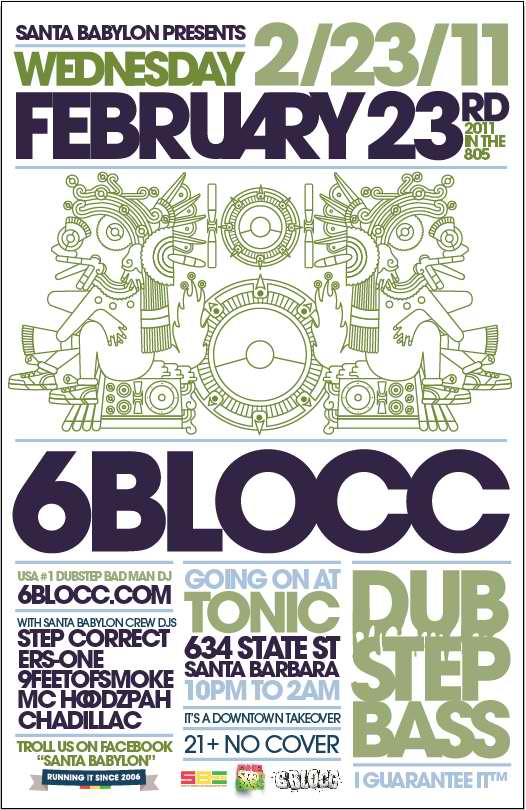
Cooking up some Chicken Tetrazzini manaña... and it's on! This Wednesday, Feb. 23rd Santa Babylon presents 6BLOCC. Rocking heads all night, all long. Come kick off 2011 with the home team, party starts at 9. 6BLOCC aka R.A.W. is the LA originator. Personally, being granted the opportunity to spit for him is a humbling experience. For those unfamiliar,6BLOCC is a double-droppin’ badman and unparalleled technical turnbalist. Starting out a hip-hop head in ‘85, he went on to reign supreme as R.A.W. in the US Jungle scene. He released “Ragga 2001” which became a landmark joint for the stateside sound on the global stage. His west-coast method behind the decks earned R.A.W. worldwide tours, mass exposure, and respect amongst the UK elite.
In 2006 he decided to try his hand at dubstep and reinvented himself as 6BLOCC. With dubstep still nascent in the US, in 2008 he mixed the now seminal LoDubs compilation 'ANALOG CLASH', which was the first release of bass weight bangers featuring producers in both Americas, exclusively. With output on labels such as Lo Dubs, N2O, Tribe Steppaz UK, Bootshake UK, La Dubstep Nostra, and the popular white label War Recordings, 6BLOCC will set the bar for Santa Barbara’s dubstep scene, with a bass that is felt for six blocks. Salsipuedes Riviera to Cabrillo Waterfront. Westside San Andres to Upper State. SB, can you feel it??
Also blazing out night will be your bassline bredren, Santa Babylon clique: ERS-ONE + STEP CORRECT + 9FEETOFSMOKE + MC HOODZPAH + CHADILLAC. This special Santa Babylon is a not miss... SB Steppas, step up!! Boomin' inna 6 block radius. P.E.A.C.E.
(Tré Mission rippin' up a Rude Kid beat with a freestyle for SB.TV) The other, far more relevant misconception garnered by an American’s perspective is that grime is foremost a culture, much like hip-hop in its day; before eroding itself through commercial interest seeping of ignorance, and decaying the less profitable ‘roots as culture’. This is understandably what makes grime so difficult to comprehend to someone on the outside listening in. In all its ambiguity, there has been one constant in grime’s experimental expanses: It’s maintained a limitative, localized nature to its UK origins. Grime even had difficulty expanding beyond London at its initial conception, and most other facets of British life, LDN still remains the creative hub for creativity for grime, as northern MC’s preferred to hop on Niche and now UKF. Until rather recent --now aged the span of a decade-- it remained almost exclusively, a nationally-bound, indigenous subculture. Well, not so exclusive anymore thanks to Tré Mission. As I earlier alluded, it becomes so difficult to export the grime sound outside of its epicenter, LDN. This is primarily because of its strong tie to culture. Nonetheless, like all good yet marginalized music, the reception of grime abroad undoubtedly does occur, however benign that regional impact. But what’s more impressive than a good UK artist having a relative hit in N. America, is for an individual listener to receive it, explore it, adore it, then innovate relentlessly upon it. This is made possible regardless of national borders, being made possible by internet 2.0; blogs, social networking, and production-software proliferation in which globalization enables. This is the track Tré Mission has wisely chosen. If done properly, an artist can create a product which can successfully be imported back to the UK without sacrificing any authenticity in calling it grime. So the reason having a Canadian breakout is well, just straight up exciting for one of the world’s most interesting sounds of the 2000s and into these coming years. Because even though grime is intrinsically British, the subculture’s principles composed within its general definition does not disqualify it as executable abroad, if the artist is able to understand and then genuinely assimilate to the subculture. Similar to Australian ex-pats of Britain who have brought grime to Australia, --although Ozzie hip-hop is leading the way down under, not its grime. In this rapid, accelerating global-socio climate, it’s no different than any former-national emigrating to take up residence in a different culture.
Tré can safely be labeled as a true pioneer for transatlantic grime, in addition to some of productions of Philadelphia’s Starkey. Although interspersed with hip-hop, Tré’s initial promo clearly overshadowed my just one in the chamber --asgrime. But in that blurry definition of “grime”, Tré is absolutely a grime emcee where mine may be debatable. Instead of solely critiquing Tré Mission in the fashion of a journalist (like most bloggers have and will continue to do), my perspective allows for me to conduct a comparative review. To promo the Toronto emcee properly, I can approach it from a contrastable level, since Tré is a similar case-study to my approach. Moreover, man straight slews me on all principles of Sama’s attributions “about what makes grime… grimey”: Keeping intact the slang, vernacular, style and attitude of grime. This can only be accomplished by authentic entrance into the cultural aspect of grime, which is difficult to do… it almost comes to you, as opposed to finding it.
Tré is 19, and like myself, is still improving and innovating upon a style that is totally different, yet strangely familiar to our own accustomed urban sound. In Tré’s case, this became evident of recent as his precisely timed releases to the scene started leaking systematically. He just dropped a free 5 track mix-tape last week, “The Practice Mission” which demo’s his progression as a grime emcee. Taking advantage of dubstep bangers (“Blood"/"Slang”) and pure grime instrumentals (Hello, Good Morning Remix) his style as a grime emcee is set, retaining an innovative Toronto flare separate from the obvious accent difference. The accent is pivotal though as it’s what ignites an initial interest, and can be attributed to his recent success back in Britain. The foreign sound of his Toronto style sets him apart from UK emcees, and can makes him arguably moregrime than some of the UK counterparts. Reason is, grime is simply a huge experiment in itself; he is adding a fresh flavor while still retaining himself as an undeniable grime artist. That notion of DIY innovation which Tré sustains is a huge part of what grime really means.
Examining Tré’s attitude and style is the most interesting aspect of his foray into becoming the top Canadian grime emcee, as it opens up another avenue for him to project himself with grandeur, aided with a voice carrying the very apparent accent differential which instantly piques one’s attention. One of grime’s primary attitudes is “reppin”. Originally reserved for East-LDN where grime was pioneered, it quickly spread throughout the UK where the further outside the center, the harder to rep. Tré Mission’s recent release features a song “Canada” in which he reps the obvious. H.E.N.C.H. and Virus Syndicate sent out grime waves once coming out strong for Bristol and Manchester, respectively. But making a grime tune reppin’ all Canada, and in proud opposition to America as the hook suggests, Tré can create a far bigger impact for reception. Currently it’s rather unrecognized, but it’s actually an interesting juncture in the whole history of grime, one of those moments which can be epitomized through one artist.
Although a Canadian grime artist teaming up with some of the UK’s elite to further his exposure is great, conversely, their also looms opportunities to successfully tap the North American market for those globally-marginalized legends which have been relegated strictly to UK popularity. They are also collaborating for a chance to capitalize on a very unique juncture in the N. American reception of grime, allowing a fresh way to market outside of their domestics. This route hasn’t really been tried effectively before. Skepta and Jammer teaming up with Shadetek was a light in the tunnel which quickly faded from view, although I still rate “Reign” as one of Skepta’s finest. Now a prospect of return seems possible... BBK in N. America?? Bros better know.
Tré’s style on the “Practice Mission” demonstrates his creative ability as a lyricist. Eventually he says this will transcend into on-coming development in productions, concepts and songwriting with grime. With all the cards he has to play, Tré is definitely the one to keep your eye on, and leaps ahead of anyone else this side of the Atlantic. The impact of his combination of beats and vocals are a force to take into consideration on a mass scale for the close-knit grime community. His first release was originally a single, “Maxin Everything”. However, a pushed backed release date will now include a few remixes of “Maxin Everything” as well as his collaboration with Wiley “Can’t Be Controlled”, all will be available at a low-cost because, as Tré says, “I love the fans”. Keep track of his forthcoming releases such as the instrumental project as well as “The First Mission” via his Twitter and Facebook accounts: @TréMission. Also check his people at SStar TV. Or see www.nosuchthing.ca. Please support the “Maxin Everything” single-pack, available through digital distributors, February 20th. You’re not just supporting an artist, you’re supporting a movement. P.E.A.C.E.Tré Mission - Canada